Uncategorized

My 50th

October 23, 2025

Trad (that’s me) was back at home in Lambeth the other day for a fiftieth birthday lunch, hosted by Christopher Woodward, director of The Garden Museum that puts Trad’s (that’s John Tradescant’s) church, the churchyard with his remarkable decorated tomb and a few of his possessions to excellent use; a shrine to horticulture. We were also celebrating, we said, Tradescant’s 600th birthday.

There are always interesting exhibitions in the little art gallery in the former church. The current one is a collection of the drawings and watercolours of Rory McEwen, surely one of the greatest plant-artists, to my eyes a rival even of Durer or Ehret or Redouté. McEwen tragically died aged only 50, a genius in many fields, musical as well as with pen and brush.

I urge you to visit the museum. It is only fifteen minutes’ walk form Parliament Square over Westminster Bridge, next door to the Tudor gatehouse of Lambeth Palace. Tradescant’s tomb (and that of Captain Bligh of The Bounty) are in the little churchyard west of the church, screened by tall plane trees from Lambeth Road. Go at lunchtime: the museum’s café serves delicious and notably stylish food, strong on fresh veg. We had whole baked brill and a chicken and mushroom pie under flaky pastry.

[rsnippet id="1" name="2nd featured image"]

The tulgey wood.

October 22, 2025

Late summer sees the Snowdonia Forest at its lushest. “Tulgey’ is Lewis Carroll’s word for it, though it’s the neighbours’ sheep, not the Jabberwock, that emerge from the leafy depths of the wood. You can tell which neighbour  by the colour of the splotches of blue or red on their wool.

We are watching the gradual filling of the new pond. We only discovered a little stream coursing down a fold in the hillside when we felled the tall spruce, to go to their destination as rafters and purlins. The stream crosses the forest road at the bottom in a culvert; block that and its water naturally fills a depression, maybe thirty yards long and wide, around what instantly became a birch-crowned island.

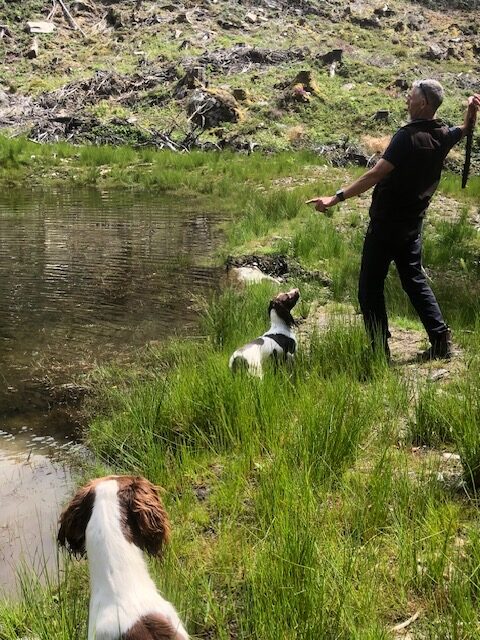
Then along comes Will, our forest manager, bringing his two white spaniels. Springers, mother and daughter. Spring? They belly-flopped noisily in, paddled to the island, scrambled up over it and trotted back to shake their coatsful of water all over us. Instantly, da capo. The performance went on into the afternoon while we measured some of the tallest trees around us. 140 feet seemed a good result since they were planted in 1964 by the Forestry Commission. In a well-rained-on part of the world (at 60 inches a year North Wales qualifies) a yard a year is good average growth. In technical forestry terms ‘Yield Class 20’ means 20 cubic metres of timber are added per hectare per year. Not bad going.

[rsnippet id="1" name="2nd featured image"]

Low Frith

August 28, 2025

If you garden by the sea you have to put up with the wind, or contrive what shelter you can. A famous garden on the shingle at Dungeness made its name with the former; one we have just visited in Cumbria ingeniously enjoys both extravagant planting and its views over Morecambe Bay within, let’s say, a bow shot rather than a stone’s throw of the sea. The solid barrier of a wall would create its own problems of wicked eddies and sneaky draughts. The preferred formula of filtering the wind calls for a screen of some kind; usually trees, that eventually lean to leeward.

At Low Frith gardening fells unconstrained, taking advantage of a range of farm buildings, the principal, a barn with its wall rising on the sheltered side, used intensively as home for delicate plants, potting shed, tool shed, and wet day resort for less hardy gardeners. It calls for a profusion of pots, robust eighteen inchers that need a sack barrow to move them and at least a barrowful of compost to fill them, not to mention dedication to water and feed them. They permit otherwise improbable combinations of plants that need totally different soils, not to mention altering their juxtapositions to suit their flowering, fruiting and the changes in the colour of their leaves.

At Low Frith a whole cohort have just been moved into, of course, a courtyard. Any new potted plants are on the small side, but so gleaming in perfect health that you stop to admire them. What is the group word for pelargoniums? Plethora sounds right to describe a score of plants pushing the limits of variety, from polished- to furry-leaved and every shade between white and crimson.

[rsnippet id="1" name="2nd featured image"]

France profonde

August 28, 2025

How does a diarist celebrate fifty years of scribbling?  Trad’s first words were in June 1965.  A little party, perhaps. A collection of favourite pieces. There are thousands of words to reread.

Someone asks, ‘How do you keep thinking up things to write about?’ Another asks “Why?” When you’ve done something for fifty years the real question is ‘Why stop?” So I won’t. Not yet. But I’ve been remembering the times when Trad has strayed beyond his usual remit and done some actual gardening. Even garden designing. Even forestry. Sadly, I have no portfolio of blueprints, just memories, a few regrets, and a feeling of satisfaction.

Obviously, I put my own gardens, the four I have owned, at the top of the list. Then came a handful of commissions, or at least advisory roles, mostly in France, most, oddly enough, with some connection to wine. They often start with a casual tour, or view from the terrace, glass in hand. ‘Do you really like that tree hiding the river?’ At Château Latour it was ‘That line of beetroot-coloured trees hiding the machine shed: all they’re doing is drawing attention to it.’

There have been failures. At the long low ‘chartreuse’ of Château Loudenne I proposed a bed of pink roses to match the walls of the chateau. When we started to dig a bed for them the soil turned out to be clay so heavy you couldn’t lift a forkful. So, this was the famous gravel, the secret of the Médoc’s inimitable claret? Trailer-loads of gravel and the entire compost heap dug in made little difference. On the other hand, the lawn sloping gently towards the river made a reasonable cricket pitch. It was fun teaching a river pilot from the Gironde just beyond the vines how to hold a bat. Not to mention using an osage orange as the ball (far too heavy).

At one chateau the French windows of the salon looked straight out at a tall hedge, entirely blocking the river view. It was not to be moved. ‘We don’t want the vineyard workers to watch us having lunch.’

The most satisfying solutions, or just suggestions, were just nudging the owners to appreciate and cultivate something they overlooked or took for granted. Sometimes there were pink carpets of cyclamen hiding in lush, neglected grass. It could be merely a low branch of a cedar stopping you from seeing the river. At Château Lafite a line of weeping willows half hides the chateau from the main road; I proposed and planted the same thing for the back drive at Château Latour. And there were interventions at Château Langoa Barton and Château Landiras.

Most of my French planting, though, was not gardening at all but forestry, at the broken-down farm in the Allier we bought for a song in 1990. Some 200 acres for something like £125,000. It sits at the very centre of the hexagon, as the French call their six-sided country, in a region of ‘bocage’; fields interspersed with oaks where nothing else of profit or interest could be coaxed into growing. Feral sheep, their fleeces shaggy, trailing, brown or black, nibbled brown grass among scraps of black plastic and barbed wire. The farmer, having despoiled the place of most of the best trees, was giving up. I had a longing for land to plant, and these two hundred acres lie on the fringe of France’s most famous oak forest, the Forêt de Tronçais.

Fifteen years later we could look back on planting over a hundred acres of trees; some pine, but mainly oak. And no more barbed wire. We could never have done it (or even got permission to do it) without the help, encouragement and friendship of Alain Macaire, then the département head of the Office National des Forêts. France is a land of generous government grants – and precious memories.

[rsnippet id="1" name="2nd featured image"]
Fish, fly-replete

August 18, 2025

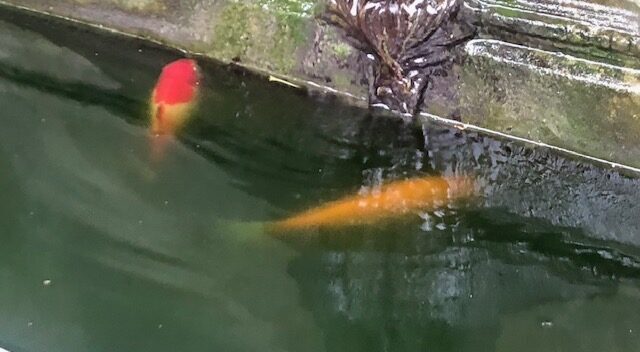
The heroes of our story: Cae and Gwian

“Fish, fly-replete, in depths of June, dawdling away their wat’ry noon.” Alas, Rupert Brooke died before making his mark as a poet. I was in his house (his father was housemaster) at school and had a crush on his memory. I also spend too long watching my two thriving goldfish in their garden tank. Their names are Cae (the gold one) and Gwian, who is red and white. They don’t, of course, speak Welsh, but they answer to their names promptly when they see their breakfast settling on the water. They survive near-freezing in winter and seem to have no objection to the water on the warm side of tepid today.

The forty-odd pots dotted around the garden are refreshed twice a day, with the thermometer showing 30 degrees C (better expressed as 86” F). Two thirds of the garden, thank goodness, lies in the shade of the house, the neighbour’s walnut and the park-size sycamore. 30 degrees feels warm enough. At our farmhouse in the Allier in the 1990s it once reached 40. We took off our clothes and lay on the tiled floor. The tall oaks in the forest around us loved it.

[rsnippet id="1" name="2nd featured image"]

Hugh’s Gardening Books

Trees

Trees was first published in 1973 as The International Book of Trees, two years after The World Atlas of Wine….

Hugh’s Wine Books

Hugh Johnson’s Pocket Wine Book

I wrote my first Pocket Wine Book in 1977, was quite surprised to be asked to revise it in 1978,…

Friends of Trad

The International Dendrology Society (IDS)