Uncategorized

Rewilding at Les Boutons

June 18, 2026

When we had plenty of space to play about with ideas (240 acres in the neglected centre of France) I went in for a spot of rewilding. I’m not sure the term existed in the 1970s, but the reality did wherever you lost control – in this case of what is known in France as ‘friche’. The dictionary translates it as ‘wasteland’, ‘fallow land’ or ‘wilderness’; in other words land that is surplus to requirements and that nobody bothers with. It is where you find out the true natural destiny of the land. In those years on our neglected farm we learned a lot.

To learn more I tried a number of experiments. I fenced off an acre or two of low-level friche; recently abandoned, I supposed, either from use producing small poles or from grazing. It didn’t take long for plenty of seedling trees to emerge from the inevitable pioneering brambles, which have the virtue of protecting them in their infancy. The saplings were almost all either hornbeam or oak. Left to grow, I reckon the eventual woodland would have been eighty or ninety per cent hornbeam.

Rewilding, then, strictly left to its own devices, will in the long run give us back the woodland that once covered the country. Plus, no doubt, an interesting selection of presumptuous exotics.

[rsnippet id="1" name="2nd featured image"]
Mad Alf

May 21, 2026

“Plagiarize; let no one else’s work evade your eyes.’ Who remembers the wicked wit of Tom Lehrer ? He puts it harshly, but the fact is that all writers feed on what others have written.

I frequently scroll through my memories of Shakespeare. Othello crops up often. “If it were now to die, ‘twere now to be most happy’ clicks in at moments of intense pleasure. Even just on smelling a rose. The sense of smell momentarily takes over from all other sensations, and even thoughts. If the olfactory nerve is closest to the memory (as I’ve been told) perhaps that includes a cut-off switch for the rest of the brain.

The rose we call ‘Mad Alf’ has scrambled twelve feet up the sycamore at the end of this garden. One hopes that Madame Alfred was as fragrant as the marvellous rose that has made her (or her name) immortal.

I still had my nose buried in her bosom at nine last night. There was complete stillness, even here, in the heart of London, but for the faint trickling of water into the little fish tank. Alas, for the moment, no fish. The heron from, presumably, Kensington Gardens, stole our little Cae and Gwian (named after our. wood in Wales). How he spotted them is a mystery. Their tank is half-buried in viburnum and ivy; its water surface only four feet by one and a half. I’m off to find their replacements; perhaps ones in camouflage colours.

[rsnippet id="1" name="2nd featured image"]

Gravetye Manor

May 5, 2026

William Robinson could be called the grandfather of modern gardening, with John Claudius Loudon as great grandfather. Loudon’s work is pretty remote today: Robinson’s though is among us still, (he founded, with Gertrude Jekyll, the original The Garden magazine) and at his own house, Gravetye Manor in Sussex, is palpable and ready for us to admire.

Gravetye is now a luxurious hotel. It’s Robinsonian origins and detailed story are precisely spelt out, and plants he describes in his writings lovingly preserved and reproduced. He died here in the year I was born: the grandfather feeling is not inherently absurd.

As a lad in Ireland in the 1880s he worked in the gardens of Curraghmore, near Waterford, the estate of the Beresfords, Marquesses of Waterford, where my own great great great grandfather Owen Johnson was steward in charge of the vast estate in the 1830s. It’s not impossible that grandpa and Robinson shared a pot of tea.

Gravetye before Robinson’s arrival was almost a wreck, the house not lived in, the grounds overgrown. Characteristically he recorded everything he did in modernizing and beautifying the hundreds of acres, planting thousands of trees to create what are now maturing beech and oak woods. From the terraces of the house, indeed, the views are entirely Robinson’s creation. The terraces look down on the lake he created. Higher on the hillside is his circular walled kitchen garden, now again in applepie order. Credit for the initial restoration belongs to Peter Herbert, formerly of the De Vere Hotel in Kensington.

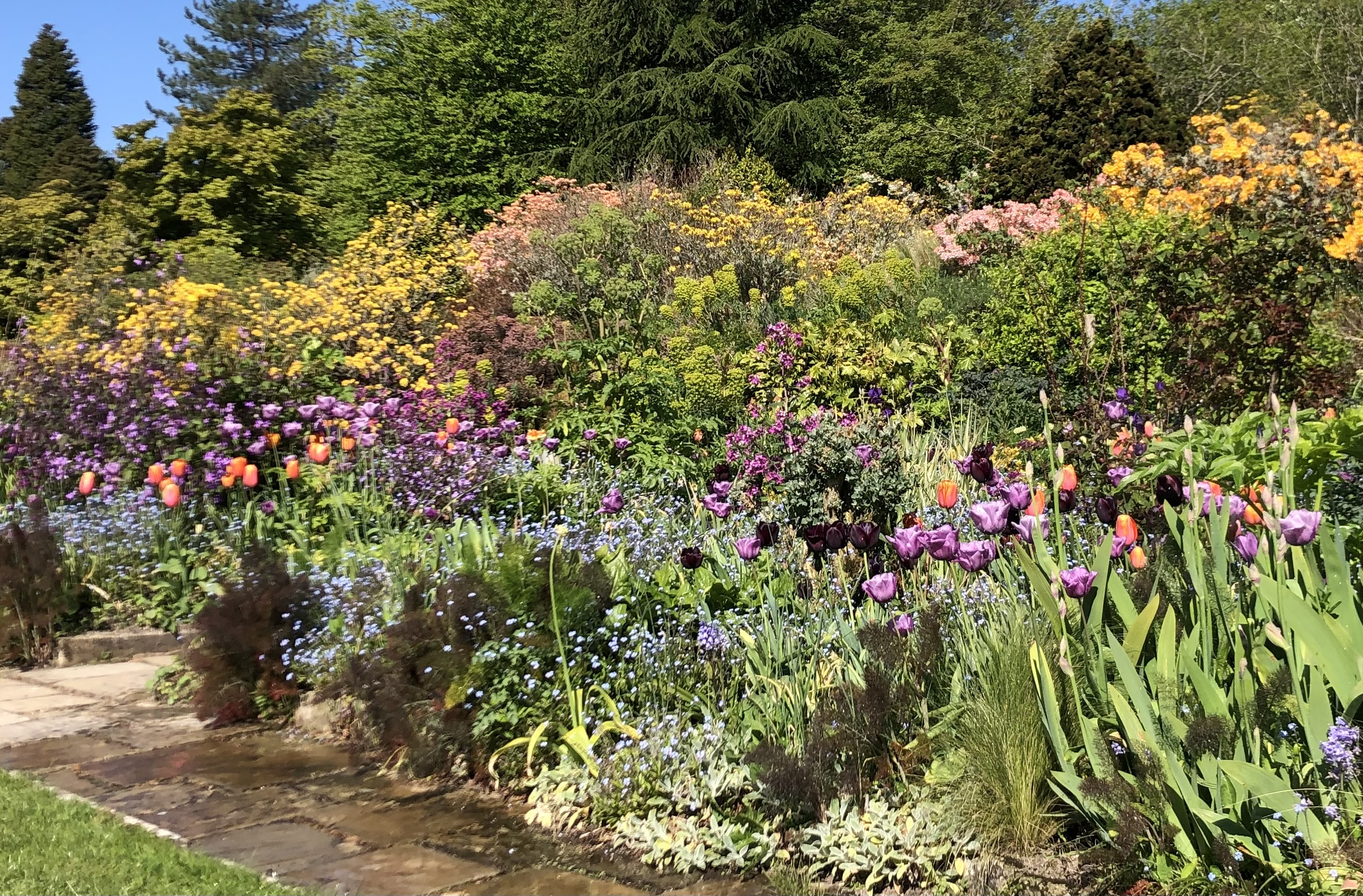
All round the house itself you walk through degrees of what Robinson called ‘wild’ gardening – though the walled garden west of the house is scarcely what anyone else would call wild. Tulips are something of a speciality here. In April they dominate the borders near the house (the dining room is separated from them only by a simple glass wall). Blue is not a common colour in tulips, but a lovely one new to me called Bleu Aimable is now on my list of bulbs to plant this autumn.

[rsnippet id="1" name="2nd featured image"]

Hergest Croft

April 21, 2026

 The road home to London from Snowdonia and our Welsh woods is long and winding. There was a blizzard of sleet as we threaded our way along the lovely green valley of the River Elan. We arrived with deep pleasure at our overnight stop, precisely on the English border and my favourite garden for half a century. Yes, Hergest Croft.

I see I first wrote in this diary about Hergest Croft in the 1970s, when the third of the five generations of the Banks family was in charge. The fourth, my friend Lawrence, my contemporary at Rugby and Treasurer of the RHS, is succeeded by his widow Elizabeth and their son Edward. They are quite a family. Elizabeth was the first professional landscape architect (her briefs included the Royal Parks) to become President of the RHS.

From the elegant new bungalow in the garden she calls her ‘enderhome’ she supervises a garden that summarises all the amenities of traditional country house walled gardens, and leads on into one of the country’s most distinguished collections of trees and shrubs, flourishing, fascinating, and mostly rare.

A further walk through rolling parkland takes you to Park Wood, a place sacred to me as where I first conceived my passion for trees. It was Lawrence’s father Dick who inducted me; tall, benign and omniscient, he introduced me to birch and silver fir as one does one to another friend. Streams and pools reflect the soaring larch and oak, a hundred feet above, with the red flowers of rhododendron arboreum mingling in the intricate canopy. Bright green and yellow skunk cabbage circles the pools where a frog plops and a flower drops from high above.

[rsnippet id="1" name="2nd featured image"]

Charcoal

March 31, 2026

Trad is not only a single-minded scribbler, he has been known to actually do some gardening, and even had a go at designing gardens. Half of them have been in France, though intervention would in most cases be a truer word than design. Several of them are related to Trad’s other obsession, wines.

Only one has been on a landscape scale; my absurdly ambitious attempt to transform the fields, woods and riverside of a more or less abandoned farm, some 240 acres in all, into a unified and recognizable ‘landskip’. It had the potential: the west slope of a small river valley facing, on the eastern crest, the traces of a Roman oppidum, its earthen ramparts still apparent. The slope was a typical forest of the centre of France, largely a mixture of oak and cherry and hornbeam, until its latest owner felled the tall wild cherries and left their trunks in rotting heaps (having no idea how to sell them).

The numbskull then tried to extract the oaks but was largely frustrated by the steepness of the land. His predecessors had more sense; they converted them to charcoal, a process that removes ninety per cent of the weight and maintains most of the value. Every twenty metres through the wood a wide black circle showed where a charcoal clamp had been. I pictured the scene fifty years before; the woodland noisy and smoky, loud with voices and axe blows, donkeys or mules ferrying the charcoal out to a wagon on the track at the top.

The little river Aumance at the bottom was too shallow to be much use. In spring it could float the raft we made of an old barn door, down past a sturdy little chateau to Vallon en Sully. The chateau (manoir is more accurate) has a stone plaque on the gateway claiming that it was the eastern most limit of an English advance from Gascony in the Hundred Years War.

Much of the farm was in a revolting state, covered with scraps of the black plastic used for covering straw bales and fiendish strands of barbed wire. Its recovery is entirely due to the generously constructive French system of grants. I wrote to the departmental office of the Eaux et Forets, the department of state established by the genius of Jean Baptiste Colbert under Louis XIV. The reply came from the boss in Moulins, the ‘country town’, Alain Maciare, who in due course became a firm friend and the source of funds I never expected. Effectively the French government subsidised my ambition to turn our scrapy property into the dignity of a ‘domaine’.

[rsnippet id="1" name="2nd featured image"]

Hugh’s Gardening Books

Sitting in the Shade

This is the third anthology of Trad’s Diary, cherry-picking the past ten years. The previous two covered the years 1975…

Hugh’s Wine Books

World Atlas of Wine 8th edition

I started work on The World Atlas of Wine almost 50 years ago, in 1970. After four editions, at six-year…

Friends of Trad

John Grimshaw’s Garden Diary